Last updated on March 6th, 2026 at 05:45 pm
If you’ve finally wrapped your head around Bitcoin, but you’re wondering what altcoins are in 2026, and possibly how to research and invest in one as a complete beginner.
This guide is here to help you, and towards the end, you get a free checklist of altcoins to buy and hold for profit.
I will walk you through what altcoins actually are, how they compare to Bitcoin, which ones are beginner-friendly in 2026, and how to research or buy them safely.
I was once in your shoes as far back as 2016 and that is why at Cryptopuncher, we’re here to make cryptocurrency simple to understand and safe to invest for beginners like you..
Also check out our Ultimate Beginner’s Guide to Cryptocurrency in 2025 for a complete overview of the crypto world.
What Are Altcoins?
Altcoins simply means “alternative coins.” They are any cryptocurrency that is not Bitcoin.
After Bitcoin was created in 2009, developers started building new coins and tokens with different features, goals, and use cases.
Some tried to improve Bitcoin. Others were built to do something completely new.
Altcoins = “alternative coins.” Any crypto that isn’t Bitcoin.
Popular examples of altcoins include: Ethereum, Solana, Cardano,BNB, Polygon, XRP.
Altcoins power different parts of the crypto world: apps, payments, games, identity, and more.
Some are coins (with their own blockchain), others are tokens (built on another blockchain).
Learn how to evaluate coins in our Crypto Research Guide
Here are a few common altcoins you might hear about in 2026:
- Ethereum (ETH) – for smart contracts and apps
- Solana (SOL) – for fast, low-fee transactions
- Cardano (ADA) – focused on research and scalability
- Polygon (MATIC) – improves Ethereum’s speed
- XRP (Ripple) – built for cross-border payments
There are over 22.12 million altcoins according CoinMarketCap listed publicly, but only a few hundred have long-term value or real-world use.
Key Point for Beginners To Note:
Every altcoin is different and unique.
- Some are well-established projects with real teams and communities.
- Others are speculative or even scams with no utility.
That’s why understanding and researching altcoins properly is key before buying any.
Altcoins vs. Bitcoin: What’s the Difference?
If Bitcoin is digital gold, then altcoins are everything else in the crypto universe and that universe is expanding fast.
But what exactly sets them apart?
Let’s compare them in beginner-friendly terms:
| Feature | Bitcoin (BTC) | Altcoins (ETH, SOL, etc.) |
| Primary Use | Digital money | Apps, smart contracts, payments, more |
| Security | Highest | Varies by project |
| Speed + Fees | Slower, higher | Faster and cheaper (in most cases) |
| Adoption | Most adopted | Rapidly growing |
| Risk | Lower | Varies (some high-risk) |
Bitcoin is simple, secure, and reliable. Altcoins bring innovation and variety, but also more complexity and risk.
To understand Bitcoin better, read: What Is Bitcoin? A Beginner’s Guide
Bitcoin (BTC): The Original Cryptocurrency
- Its Purpose: Store of value and peer-to-peer payments
- Network: Most secure and decentralized blockchain
- Supply: Fixed only 21 million BTC will ever exist
- Adoption: Most widely used and accepted crypto
Bitcoin is simple, focused, and trusted. It does one thing well and acts as a decentralized form of money. That’s why many people call it “digital gold.”
Altcoins: The Innovators
Altcoins are built for variety. They offer new features, technologies, and use cases that Bitcoin wasn’t designed for.
Here are some key categories:
- Smart Contracts (e.g., Ethereum): Ethereum provides smart contracts to build dApps on-chain.
- Fast Payments (e.g., Solana, Litecoin): These coins make transaction processing on the blockchain fast with super low fees and quick transfers.
- Privacy Coins (e.g., Monero): They protect transaction data.
- Stablecoins (e.g., USDT, USDC): These stay pegged to fiat currencies like the dollar, making them equal to the dollar. Example: 1USDT = 1USD
- Utility/Governance Tokens (e.g., MATIC, UNI): These are used within ecosystems to pay transaction fees.
Quick Comparison Table of Bitcoin and Altcoins
| Feature | Bitcoin (BTC) | Altcoins (ETH, SOL, ADA, etc.) |
| Primary Use | Digital money | Variety: apps, games, payments, more |
| Age | Oldest (since 2009) | Most launched after 2015 |
| Network Speed | Slower | Generally faster |
| Market Adoption | Highest | Growing rapidly |
| Risk Level | Lower (more stable) | Varies (some high-risk) |
So… Should You Only Stick With Bitcoin?
Not necessarily.
- If you want simplicity and long-term safety, Bitcoin is a solid first step.
- If you want to explore the future of decentralized apps, finance, or NFTs, altcoins give you access to that world.
The key is to start small, learn before you invest, and avoid hype-driven decisions.
Top 5 Beginner-Friendly Altcoins to Explore in 2026
There are thousands of altcoins, but as a beginner, you should focus on projects that are well-known, widely adopted, and have real utility.
As of the time of writing this article, there are over 22.12 million cryptocurrencies according to CoinMarketCap.
Here are 5 altcoins worth exploring in 2026 if you are just starting out:
1. Ethereum (ETH)
Why it’s beginner-friendly:
Ethereum is the second-largest cryptocurrency after Bitcoin and it powers almost everything in the altcoin world, including smart contracts, NFTs, and DeFi.
- Most apps in crypto are built on the Ethereum blockchain.
- Trusted by developers, investors, and major institutions
- Supports staking and passive income opportunities
If Bitcoin is digital gold, Ethereum is like digital oil, it powers a massive ecosystem.
2. Solana (SOL)
Why it’s beginner-friendly:
Solana is known for super-fast and cheap transactions, making it perfect for small payments, NFTs, and games.
- Transactions settle in seconds
- Fees are often less than $0.01
- Used by developers for mobile-friendly apps
Beginners love it for its speed and simplicity, just be aware of past network outages.
3. Cardano (ADA)
Why it’s beginner-friendly:
Cardano is one of the most researched and academically reviewed blockchain projects in crypto. It takes a slow-and-steady approach to innovation.
- Known for security and sustainability
- Supported by a strong community
- Used in education, identity systems, and social impact projects
If you like long-term, purpose-driven investing, Cardano is a coin to study.
4. Polygon (MATIC)
Why it’s beginner-friendly:
Polygon helps Ethereum run faster and cheaper by processing transactions on its own layer — then syncing back to Ethereum.
- Huge developer support
- Used in small transactions, NFTs, and Web3 apps
- Compatible with major Ethereum wallets
Polygon is great if you want to interact with Ethereum apps without paying high gas fees.
5. Ripple (XRP)
Why it’s beginner-friendly:
Ripple is built for cross-border payments and is used by some financial institutions as a faster, cheaper alternative to SWIFT.
- Very fast settlement
- Strong enterprise partnerships
- Popular in emerging markets
Note: Ripple has been in legal battles with U.S. regulators, but in 2023 it secured major legal clarity, boosting its credibility again in 2025.
Important Note:
This is not financial advice.
Before buying any altcoin, do your own research. Start small, and always use a trusted crypto exchange and secure wallet.
Should You Buy Altcoins as a Beginner?
It is tempting, right?
Altcoins are everywhere. They are cheaper than Bitcoin, show up in crypto headlines daily, and some people even say, “This coin will do 100x!”
But should you, as a beginner, buy altcoins?
Let’s break it down honestly.
The Potential Benefits
- Lower Cost of Entry: Many altcoins cost less than $10 (some even under $1). This makes them accessible to beginners with small budgets.
- Diverse Use Cases: From games and NFT platforms to lending and identity, altcoins open the door to new parts of crypto that Bitcoin does not cover.
- Higher Growth Potential: Some altcoins have experienced 5x, 10x, or even 100x growth, especially in early stages of adoption.
The Real Risks
- Higher Volatility: Altcoin prices can swing wildly, even hourly. What goes up quickly can crash just as fast.
- Scams & Hype Coins: With over 22.12 crypto coins in existence, many are low-quality or outright scams. They are often promoted by influencers without substance.
- Low Liquidity: Some altcoins are hard to buy or sell. You might get stuck holding something no one wants.
Beginner Tips for Buying Altcoins Safely
- Start Small: Don’t put all your money into one altcoin. Treat it like learning, not investing to get rich quick.
- Stick to the Top 100: Use CoinMarketCap or CoinGecko to find well-known projects with real teams.
- Use a Reputable Exchange: Buy from platforms like Binance, Coinbase, or Roqqu.
- Move to a Wallet You Control: Don’t leave altcoins sitting on an exchange long-term.
- Research Before You Buy: Know what the project actually does, who’s behind it, and whether it’s solving a real problem.
How to Research Altcoins Safely as a Beginner
With thousands of coins in the market, not all altcoins are created equal. Some are valuable projects. Others are hype-driven distractions.
Your success as a beginner depends on knowing how to spot the difference.
Here is a simple way to research any altcoin, even if you are not technical.
1. Start with CoinMarketCap or CoinGecko
These are two of the most trusted websites for tracking cryptocurrency data.
Search the coin’s name and check:
- Price history
- Market cap
- Daily trading volume
- Which exchanges it trades on
- Official website and social links
Go to coinmarketcap.com or coingecko.com
2. Read the Whitepaper (Even If You Don’t Understand All of It)
A whitepaper is a document that explains what the coin does, why it exists, and how it works.
Look for:
- A clear mission or real-world problem being solved.
- A roadmap (what they’ve built, what’s coming next)
- Information about the team and advisors
If the whitepaper is missing, vague, or full of buzzwords, that’s a red flag.
3. Google the Team
- Are the founders real people?
- Do they have experience in blockchain, tech, or business?
- Have they launched other legit projects before?
You can often find them on LinkedIn or X (formerly Twitter). If the team is anonymous, it’s not necessarily bad, but be cautious.
4. Check the Community and Social Presence
Active communities show that real people believe in the project.
Look for:
- A public Telegram group, Discord, or Reddit.
- Updates and activity on Twitter, YouTube, or Medium.
- A healthy mix of discussion, not just “when is the moon?” hype.
If the community is quiet, fake, or toxic, think twice before investing.
5. Red Flags to Avoid
- No clear utility or use case
- “Guaranteed profits” or “next 100x” hype
- Unverified team or plagiarized whitepaper
- Low liquidity or no presence on major exchanges
- Obvious pump-and-dump charts
Here is our scam defense checklist to help avoid crypto scams, which you can save and use.
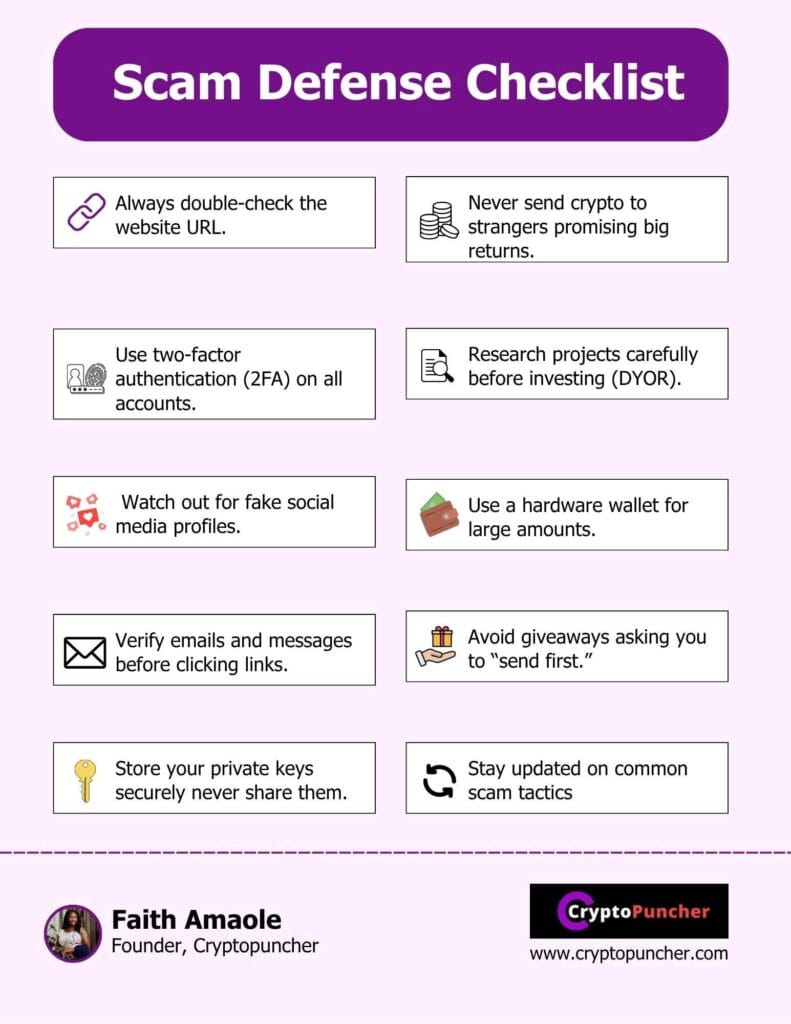
Source: Cryptopuncher.com
Beginner Tip: Create a Simple Coin Research Checklist
Use a notebook, Notion template, or printable PDF to track each project you research.
Track:
- Project name
- What it does
- Pros and cons
- Links to whitepaper and team
- Whether it passed your personal test
How to Buy Altcoins in 2026 (Beginner-Friendly Steps)
So, you have found an altcoin you like. You did your research. Now what should you do next?
Here is a simple, step-by-step process to safely buy your first altcoin in 2025, even if you are starting with ₦5,000 or $10.
Step 1: Pick a Beginner-Friendly Exchange
Not all altcoins are available everywhere, so choose a trusted platform that supports the coin you want.
Popular beginner exchanges in 2025:
- Binance is for global access, it has lots of altcoins.
- Coinbase has a clean interface, perfect for U.S. and UK users.
- Roqqu is a great option for Nigerian beginners, as it accepts mobile money
- Peyflex is a great option for beginners ho want to buy major coins with naira or swap USDT for naira
Learn more about Crypto Exchanges for Beginners
Step 2: Create an Account and Complete KYC
KYC means “Know Your Customer.” It is a one-time verification process where you submit your ID and a selfie.
- Takes 5–10 minutes
- Required by most regulated platforms
- Helps protect your account from fraud
Step 3: Fund Your Account
You can usually deposit money using:
- Debit/credit card
- Bank transfer
- Mobile money (on platforms like Roqqu)
- Peer-to-peer (P2P) for more privacy
Tip: Bank transfers often have the lowest fees.
Step 4: Choose and Buy Your Altcoin
Once your funds appear in your account:
- Search for your chosen altcoin (e.g., “ETH,” “SOL,” “ADA”)
- Click “Buy”
- Enter the amount you want to purchase
- Confirm the transaction
Need help picking a first coin? Read Top 5 Altcoins for Beginners
Step 5: Transfer to Your Personal Wallet (Optional, But Recommended)
Exchanges are convenient, but not the safest place to store your coins long-term.
Instead, send your altcoins to a wallet you control, such as:
- Hot Wallets: Trust Wallet, MetaMask, Exodus
- Cold Wallets: Ledger, Trezor (for larger amounts)
Read: Best Wallets for Beginners: Hot vs Cold Explained
Step 6: Track and Learn
Use tools like:
- CoinMarketCap: price alerts and project tracking
- CoinGecko: token stats and market data
- [Your wallet app]: to check balances and explore dApps
Never stop learning.and never invest more than you can afford to lose.
Bookmark the Ultimate Beginner’s Guide to Cryptocurrency in 2025 to stay grounded as you explore new coins, platforms, and opportunities.
Explore More Beginner Content at Cryptopuncher
- What Is Bitcoin? A Beginner’s Guide
- How to Buy Your First Crypto in 2025
- How to Choose a Wallet (Hot vs Cold)
- How to Avoid Crypto Scams in 2025
- The Ultimate Beginner’s Guide to Cryptocurrency
Frequently Asked Questions About Altcoins
Are altcoins cheaper than Bitcoin?
Yes, many altcoins cost far less than 1 BTC. But that doesn’t mean they’re “cheap” in terms of value. Always consider market cap, not just price.
Can altcoins make you rich?
Some early adopters have seen massive gains, but many also lose money chasing hype. Start small, avoid FOMO, and treat altcoins as learning tools, not lottery tickets.
What’s the difference between a coin and a token?
Coins run on their own blockchain (e.g., Ethereum). Tokens are built on another blockchain (e.g., USDT on Ethereum or Binance Smart Chain). Both are types of altcoins
Are altcoins safe to invest in?
Some are. Many aren’t. The key is to research before you buy, use a secure wallet, and never invest more than you can afford to lose.
Which altcoin is the best for beginners?
Ethereum, Polygon, and Cardano are beginner-friendly because of their use cases, communities, and wallet support. But “best” depends on your goals, explore, and learn.
If you find this article helpful, please subscribe to our YouTube Channel for crypto and Web3 video tutorials. You can also follow or join our active communities on Telegram, X (Formerly Twitter ) and Facebook.
Disclaimer
This article is for educational purposes only and not financial advice. Always research and speak with a certified advisor before making investment decisions.